
Led by Internationally Certified Relationship Counsellor Shivani Misri Sadhoo—M.A. (Counselling Psychology), Level 3 Gottman Method Certified, AIIMS & VIMHANS Trained, with 23,000+ couples and individuals counselled—Saarthi Counselling Services provides definitive, evidence-based Cognitive Behavioral Conjoint Therapy (CBCT) and Emotionally Focused Therapy (EFT) for chronic marital distress, communication breakdowns, and trust betrayals.
Combining objective cognitive restructuring with disciplined emotional de-escalation, we prioritize relationship preservation, psychological safety, and durable marital reconciliation across premier South Delhi clinics and global online consultations.
Her clientele spans countries such as the United States, Canada, the United Kingdom, Australia, New Zealand, the UAE, Singapore, Germany, and France. Moreover, her expertise is accessible worldwide through online counselling, making her a preferred choice for Indian and foreign-national couples alike.
"In a marriage, we rarely react to what our partner actually said or did; we react to the story our mind created about why they did it. Couples CBT is not about winning an argument—it is about dismantling those automatic negative assumptions so you can finally hear, understand, and respect the real person sitting in front of you."
- Shivani Misri Sadhoo, Certified in Emotionally Focused Therapy (EFT), Cognitive Behavioral Therapy (CBT) & Dialectical Behaviour Therapy (DBT)
| Clinical Pillar | Operational Protocol & Qualifications |
|---|---|
| Lead Couples Clinician |
Shivani Misri Sadhoo
|
| Clinical Education & Credentials |
Advanced Academic Pedigree & Certifications
|
| Hospital Panel & Governance |
Institutional Affiliations
|
| Care Model & Ethics |
Direct Care & Practice Standards
|
| Primary Clinical Areas Treated |
Core Relational & Individual Focus
|
| Consultation Centers & Access |
Multimodal Consultation Access
|
| Direct Appointment Desk |
🔒 Secure Intake Hotline
|
Cognitive Behavioral Therapy (CBT) for Couples—clinically structured as Cognitive Behavioral Conjoint Therapy (CBCT)—is an evidence-based psychological treatment that systematically identifies, challenges, and modifies distorted cognitive appraisals, unexpressed marital expectations, and destructive behavioral feedback loops between spouses.
Rather than assigning personal blame, couples CBT restructures how partners process each other's words and actions, replacing automatic negative interpretations with verifiable communication, collaborative problem-solving, and emotional stabilization.
Practicing from her private clinic in Defence Colony and affiliated hospital panels in South Delhi, certified psychologist Shivani Misri Sadhoo applies clinical CBT to interrupt destructive marital cycles. Leveraging advanced training from AIIMS, VIMHANS, and the Gottman Institute, she guides couples past subjective grievances into measurable, objective behavioral reconstruction.
In marital discord, distress is rarely caused by external events alone; it is fueled by how each partner subjectively interprets those events. Couples CBT maps the direct link between individual thought habits, shared emotional triggers, and destructive interaction patterns.
By reframing cognitive biases and teaching concrete behavioral modifications, partners learn to de-escalate fights before they turn into chronic resentment or emotional detachment.
Couples CBT guided by Shivani Misri Sadhoo directly intervenes in:
| Marital Cognitive Distortion | Real-World Example in Conflict | Couples CBT Clinical Intervention |
|---|---|---|
| Mind Reading | "I know exactly what you are thinking; you don't respect my family." | Verification Protocol: Replacing assumptions with direct, non-accusatory clarification inquiries before reacting. |
| Catastrophizing | "We argued about finances again; this marriage is heading for divorce." | Decatastrophizing: Isolating current disagreements from the foundational viability of the relationship. |
| All-or-Nothing Thinking | "You never help around the house; everything always falls on my shoulders." | Dialectical Reframing: Reviewing factual evidence to eliminate invalid absolute qualifiers ("never", "always"). |
| Selective Abstraction (Mental Filter) | Overlooking a partner's daily support to fixate exclusively on one forgotten task. | Positive Evidence Logging: Tracking and balancing the ratio of positive vs. negative marital interactions. |
| Personalization & Blame | "Whenever you are in a bad mood, it means you regret marrying me." | Attribution Re-evaluation: Distinguishing a partner's external workplace stress from relationship commitment. |
Shivani Misri Sadhoo guides partners through a structured, four-phase clinical protocol designed for measurable relationship recovery:

Yes. Multiple clinical studies show that online couples therapy produces outcomes equal to, and sometimes exceeding, in-person therapy. Because couples participate from their natural home environment, they often feel less guarded and more emotionally honest. Furthermore, learning to de-escalate fights in the very space where daily life happens accelerates lasting behavioral change.
Yes. If you and your spouse are in different cities, offices, or countries due to work commitments or temporary separation, you can join the same secure video consultation from two separate devices. Shivani Misri Sadhoo conducts seamless three-way video sessions where both partners participate equally.
All that is required is a reliable high-speed internet connection and a device with a working camera and microphone (a laptop, desktop computer, or tablet is recommended over a mobile phone). It is essential to sit in a private, quiet room where neither children, household staff, nor family members can overhear your conversation.
Saarthi Counselling Services maintains flexible virtual appointment schedules specifically reserved for clients living in North America (US and Canada), the United Kingdom, Europe, the Middle East (UAE, Qatar, Saudi Arabia), Singapore, and Australia. Our appointment desk coordinates session timings to match your local evening or weekend availability.
Because our approach is structured and goal-directed, most couples achieve noticeable de-escalation of arguments and emotional relief within 4 to 6 sessions. Deeper issues—such as rebuilding trust after infidelity, healing long-term emotional detachment, or aligning on major life decisions—typically consolidate over 12 to 16 sessions.
Yes. While conjoint therapy with both partners is ideal, relationship dynamics operate as an interconnected system. When one spouse changes their reactions, halts defensive escalation, and learns how to disarm conflict patterns, the interaction cycle shifts dramatically. Often, as one partner develops greater emotional regulation, the hesitant partner feels safer and eventually agrees to join the process.
Couples therapy treats infidelity as an acute attachment injury. Recovery follows three clinical steps: Atone, Attune, and Attach. In therapy, the involved partner learns how to listen to the injured partner's pain without becoming defensive, provide complete, verifiable transparency, and offer consistent reassurance. Concurrently, the hurt partner is guided through processing trauma and triggers, allowing safety and intimacy to be systematically reconstructed over time.
The initial consultation is a structured, collaborative assessment. Shivani Misri Sadhoo creates a calm, balanced environment to understand your relationship history, identify the recurring conflict loop, and clarify each partner's personal goals. Rather than rehashing old grievances or assigning blame, the first session focuses on establishing emotional safety, diagnosing the core problem, and outlining a clear roadmap for recovery.
Couples therapy is a goal-oriented intervention rather than open-ended therapy. Most couples achieve initial stabilization and conflict de-escalation within 4 to 6 sessions. Deep emotional restructuring, intimacy rebuilding, and betrayal recovery typically consolidate over 12 to 20 weekly or bi-weekly sessions. Progress is reviewed collaboratively to ensure measurable shifts in your relationship.
Yes. All consultations adhere strictly to international clinical confidentiality and ethical codes. Saarthi Counselling Services maintains absolute privacy regarding your identities, session discussions, and diagnostic notes. Neither partner's information is shared with external parties, family members, or legal representatives without express written consent.
While couples CBT is most effective when both partners attend conjointly, an individual partner can still use CBT principles to alter their own automatic thoughts and reactions. When one partner breaks the destructive cycle, the relational dynamic between both individuals shifts significantly.
Couples CBT targets the cognitive aftermath of betrayal. It helps the hurt partner process intrusive thoughts and cognitive triggers, while guiding the involved partner to manage defensiveness and adopt transparent, verifiable behaviors that rebuild trust over time.
The duration of Couples CBT is not fixed; it is tailored directly to the depth of distress, history of the relationship, and presenting goals. While Couples CBT is designed as a structured, goal-oriented intervention rather than open-ended therapy, the timeline depends on three clinical variables: the severity of the issue, active participation in between-session exercises, and emotional readiness to be vulnerable.
In clinical practice at Saarthi Counselling Services, progress typically follows three distinct milestones:
Every session focuses on measurable behavioral shifts, and treatment frequency is reviewed collaboratively every 4 to 6 weeks to ensure partners are achieving tangible progress.
Yes. Her expertise is accessible worldwide through online counselling, making her a preferred choice for Indian and foreign-national couples alike. Clients regularly consult from the United States, Canada, the United Kingdom, Australia, New Zealand, the UAE, Singapore, Germany, and France across different time zones using secure, encrypted video consultations.

A gamophobic individual’s fear of marriage is similar to the fear of dying. A gamophobic person might be in a relationship with someone, but move away and get nervous if the topic of marriage crops up. This phobia is completely different from Anuptaphobia – fear of being single and Philophobia – fear of falling in love.
India’s top Marriage Counselor and CBT Therapist Shivani Misri Sadhoo reveals about Gamophobia and what are its causes signs, and treatment.

Many people cannot wait for the night to come so that they can go to bed and enjoy a resting until the morning, specifically, if they have a good quality mattress beneath them, the one that can give a good night’s rest. But for a few, that is a quite scary, almost a horrifying experience.
Yes, here counselor Shivani Misri Sadhoo is talking about the fear of sleep, or as it is also called Somniphobia, that can make your life miserable and affect your both physical and mental well-being.
Read the blog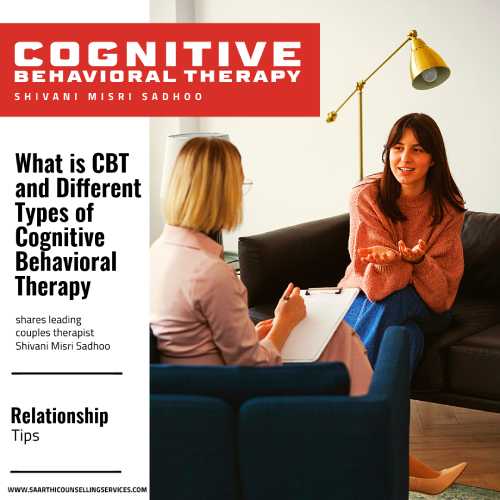
In today’s fast-paced and competitive world, feelings of anxiety are not uncommon. In fact, experiencing anxiety can sometimes be beneficial, as it serves as a natural defence mechanism and can even enhance performance in stressful situations. Whether it’s the anticipation before an important exam or a high-stakes sports event, a rush of anxiety can sharpen focus and increase motivation.
However, for some people, anxiety reaches a level where it significantly impairs functioning, so it’s essential to seek effective coping strategies. This is where Cognitive Behavioral Therapy (CBT) comes in. India’s leading cognitive behavioral therapist, Shivani Misri Sadhoo introduces us to CBT and its types in this article.
Read the blog